
By News Central Marketing
Paying for a meal or shopping overseas could eventually become as simple as scanning a QR code for RCBC customers, as the Philippine bank explores connecting to a cross-border payment network covering major Asian markets.
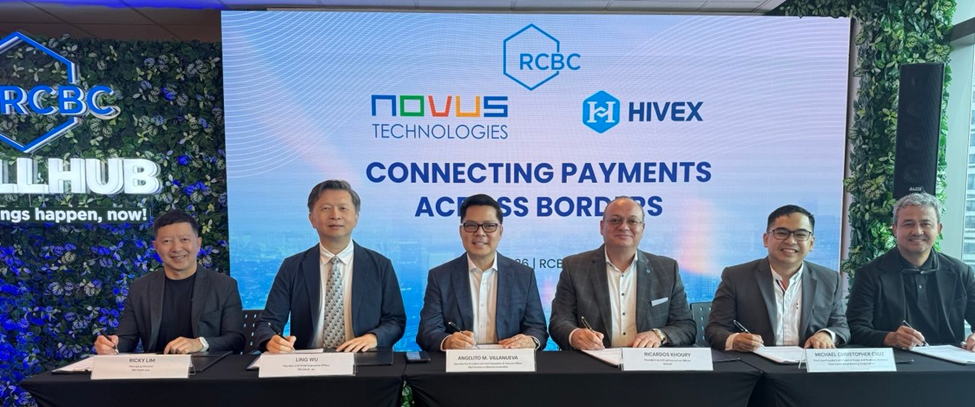
Rizal Commercial Banking Corporation (RCBC) and Novus Transact Philippines Corporation have signed a memorandum of understanding to evaluate RCBC’s potential connection to HIVEX, a cross-border payment network developed by TBCASoft.
The collaboration could expand QR payment interoperability between the Philippines and markets including Japan, South Korea, Taiwan, China, and other Southeast Asian countries.
If implemented, the arrangement would provide new payment options for both international visitors spending in the Philippines and eligible Filipino users traveling abroad.
Making local QR payments work across borders
Under the proposed setup, RCBC and Novus will explore allowing users of participating HIVEX wallet partners to make person-to-merchant payments at QR Ph merchants in the Philippines.
The companies will also evaluate outbound capabilities that could enable eligible RCBC wallet users to scan and pay at participating HIVEX merchants overseas.
The goal is to make cross-border transactions feel more like domestic QR payments, potentially reducing the friction consumers face when switching between different payment systems while traveling.
The partnership remains at the exploratory stage. RCBC and Novus will assess the technical, operational, commercial, and regulatory requirements before any future implementation.
For Philippine merchants, greater interoperability could also mean access to payments from more international visitors without requiring entirely separate acceptance systems.
Connecting domestic payment ecosystems
Developed by TBCASoft, HIVEX is designed to connect domestic payment ecosystems across markets while allowing participating financial institutions to maintain their existing governance, compliance frameworks, and customer relationships.
Ling Wu, CEO of TBCASoft, said the network aims to connect payment systems without compromising national data boundaries.
“In an AI-driven era where data sovereignty and user privacy are non-negotiable, our network bridges domestic ecosystems without compromising national data boundaries,” Wu said.
“Partnering with forward-looking leaders like RCBC and Novus allows us to extend this secure, sovereign connectivity to the Philippines—making international payments as effortless as domestic ones,” he added.
RCBC looks beyond domestic digital payments
For RCBC, the initiative extends its push into digital financial services and payment accessibility.
“RCBC is committed to bringing innovative and inclusive payment solutions to our customers,” said Lito Villanueva, RCBC Executive Vice President and Chief Innovation and Inclusion Officer.
“We look forward to working with TBCASoft and Novus to unlock more seamless cross-border QR payment experiences for Filipinos while supporting the continued growth of digital payments and international commerce,” Villanueva added.
Novus, meanwhile, will bring its existing technology relationship with RCBC into the proposed cross-border payment infrastructure.
Novus Technologies founder and CEO Ricardos Khoury said the company already supports RCBC’s ATM Go platform and will serve as HIVEX’s gateway and customer support partner in the Philippines.
QR payments enter their cross-border era
The proposed connection comes as QR payments increasingly move beyond domestic use and become part of the infrastructure supporting international travel and commerce.
For consumers, the appeal is straightforward: use a familiar payment method even when crossing borders. For merchants, interoperability can open another channel for accepting payments from foreign customers.
RCBC, Novus, and TBCASoft still need to work through the requirements necessary to bring the service to market.
But if the proposed integration moves forward, a QR code already familiar to Filipino consumers could become considerably more useful—turning a smartphone into a payment tool not just at home, but across a growing network of Asian destinations.
See full post here.